

Posted by Jake Heying on Sep 14th 2026
How Many Times Can You Clean a Diesel Air Filter?
No, there is no set number, and anyone who hands you one is guessing. A diesel primary air filter is done when the media tears, the seal goes bad, or restriction will not come back down after a proper cleaning. Not when a counter hits three. How many cleanings you get out of an element comes down to two things: the pressure and direction of the air you clean it with, and whether you actually look at the element before it goes back in the housing. Clean it with regulated air from the inside out and inspect it every time, and a primary will go far more rounds than most operators expect. Hit it with 150 psi straight off the compressor, and you can ruin one on the first pass.
Key takeaways
- There is no fixed cleaning limit. Condition and restriction decide, not a count.
- The "two or three times" figure comes from people cleaning with straight shop air, which tears media.
- In our field testing, one element was cleaned 29 times in eight days and still passed a light check.
- Inspect every element before it goes back in. That one step is what makes reuse safe.
- Never clean a safety filter. If it is dirty, replace both elements and find out why.
Is there a set number of cleanings?
Fair thing to ask in September. You are pulling an element out of a combine or a grain cart every evening, and in the back of your head is a number somebody told you once: two or three cleanings and pitch it.
Start with your operator manual. Some machine manuals put a hard cap on the primary, a set number of cleanings and then replacement after a year in service no matter how it looks. If yours does, follow it. That is a warranty question as much as a maintenance one.
Past that, condition decides. Donaldson makes the point well in its guidance on servicing filters by restriction instead of appearance. A partly loaded cellulose element traps finer dust than a brand new one, right up until restriction climbs too high. So the filter that looks filthy may have plenty left in it. And the one that looks fine may have a pinhole you will never spot standing three feet away.
You cannot count your way to a safe answer. You cannot eyeball your way there either. Watch restriction, and look the element over with a light before it goes back in.
Why does everybody say two or three?
Because that is about what you get with the method most people use.
The average guy cleaning a filter is running 125 to 150 psi straight out of the compressor through a single nozzle, and half the time he is blowing from the outside in. That drives dirt deeper into the media instead of out of it. Concentrated pressure in one spot tears the paper between the pleats. Two or three cleanings is generous under those conditions. Then there is the fellow banging the element on a tire to knock the dust loose. And the one who washes cellulose media in soapy water. Both of those are one and done.
Caterpillar goes further than the filter makers and tells you not to clean engine air filters at all. I do not blame them. They cannot control how you do it and they cannot verify the element afterward. The safe rule is the only rule they can write.
But read what that rule actually says. Most people clean filters badly, and nobody checks their work. That is a different claim from a properly cleaned and inspected element being untrustworthy.
What did our testing actually show?
We took one filter and cleaned it with the Filter Blaster several times a day, eight straight days. Twenty-nine cleanings. Then we put a fluorescent light inside it and went over the element. It was still in perfect shape. The testing referenced on our FAQ page went further, hundreds of canister filters deliberately plugged and cleaned 60 times each, no single tear. The full write-ups are on our field testing page.
Why does the number matter in a dusty season? In our two-tractor trial we ran a pair of identical John Deere 7750s, right at 600 horsepower each, same field, same 12-hour day, both starting on new filters. The next morning we cleaned one and pulled over four and a half pounds of dirt out of it. We left the other alone. By the end of day two, the tractor with the dirty filter had burned 58 more gallons of fuel. Both elements were mostly plugged after a single day of work. Those figures happened on that job, not in a lab, and results depend on your equipment, dust load, hours, and how the maintenance gets done. So take them as what happened there, not a promise.
Here is the part that bites in a dusty season. You are cleaning that filter every day. At that rate, the gap between three cleanings and thirty is your parts bill for the whole run. The bigger the machine, the bigger that gap.
What ends a filter's life?
Six things. Not one of them is a number on a clipboard:
- A hole, split, or thin spot in the media. A light inside the element finds these.
- A sealing ring that is cracked, hardened, or has taken a permanent set. The seal fails more often than the paper does.
- Dented or crushed end caps and outer screen, usually from somebody knocking the element against something.
- Oil, fuel, or coolant in the media. Air will not fix that. Neither will anything else.
- Caked mud. Moisture packs dirt into the pleats and makes it far harder to move. A filter that got soaked and then dried into a brick is done.
- Starting fluid, which makes the media brittle. Do not spray it into the intake. Ever.
There is one more signal no inspection will show you. Clean an element correctly and restriction stays high anyway. The media is loaded to where air will not pass through it. That filter gave you what it had.
How do you inspect an element before it goes back in?
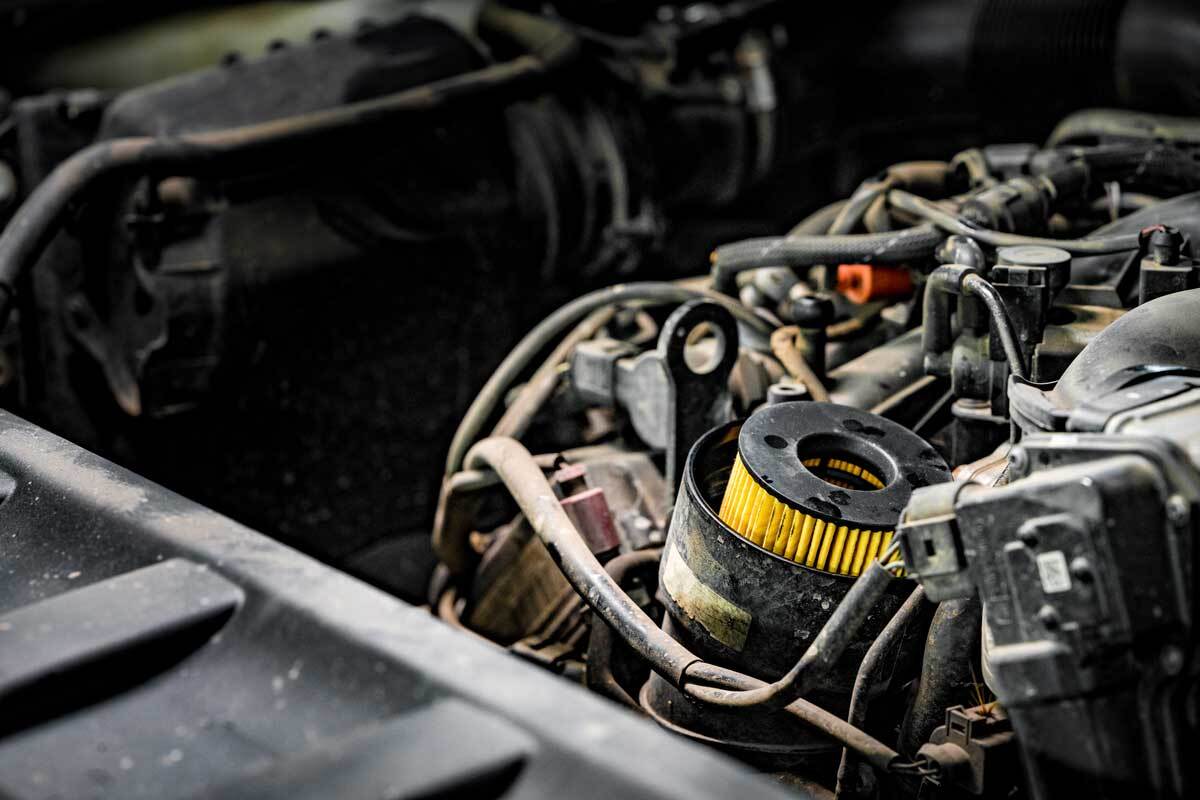
Put a light inside it. Turn the element slowly and look for pinpricks of light coming through. Watch the fold lines, because that is where tears start. Run a thumb all the way around the sealing ring, feel for hard spots, cracks, a flat area. Check the end caps for dents.
Then look at the clean side. Fine gray dust inside the element or in the outlet tube means air is getting around your filter and the engine has already been eating dirt. That is the finding that changes your whole day. Replace both elements and figure out where it got in.
Wipe the housing with a clean lint-free rag, working from the back toward the opening so you pull dirt away from the engine. The whole check runs about 30 seconds once you have done it a few times. A filter costs less than a turbo, and that is true every day of the week. The full procedure is in our guide to cleaning a diesel air filter without wrecking it.
Does pulling the filter to check it do more harm than good?
It can. That is the strongest argument the filter companies make. Every time you open the housing you invite dust into the clean side and give yourself another chance to seat an element crooked. Over-servicing is a real way to dust an engine.
The answer is not to skip the inspection. It is to quit opening the housing on a hunch. Let the restriction gauge tell you when the element needs service. Then clean it properly and inspect it properly while it is in your hands. Service by the gauge, inspect by the light. Do not pull filters just to look at them. And never put one back without looking at it.
What about the safety filter?
You do not clean it. Not with the Filter Blaster. Not with shop air. Not with anything. The inner element is the last thing standing between a failed primary and your cylinders. It is not built to be serviced, and there is no way to verify it once you have messed with it. Caterpillar and Donaldson both put it the same way. Replace the safety element about every third primary change, more often in heavy dust.
Pull that inner element and find dust on it, and stop. The primary failed or the seal leaked. Replace both, clean the housing, and find the leak before the machine goes back to work.
Where the Filter Blaster fits
The reason our cleaning counts look nothing like the two or three quoted online is the method, not the marketing. The Filter Blaster Portable Unit seals to the element and runs on 100 psi supply air. It distributes that air so no single air jacket puts out more than about 48 psi. Air enters the centrifugal chamber, spins the shaft, and vibrates dirt out from the inside of the filter toward the outside, the direction it came in. No concentrated blast on one spot of the pleats. That is the whole patent, and it is why an element cleaned this way keeps passing the light check. Here is how the method compares to the alternatives.
Questions we get asked
How many times can I clean my filter with the Filter Blaster?
Plan on many times the life of the element, as long as you inspect it before every reinstall. Our testing put 29 cleanings on one filter in eight days with no damage. The canister filter testing on our FAQ page reached 60 cleanings each without a tear. Your dust and your equipment set the real number. The inspection settles it, not the count.
Can I wash a diesel air filter with water or soap?
No. Cellulose media is not washable. Water swells the fibers and weakens the paper. You end up with a filter that looks fine and fails quietly. An oil-soaked or mud-caked element is a replacement, full stop.
Does a cleaned filter protect the engine as well as a new one?
An intact element cleaned properly filters well. A partly loaded one catches finer particles than a brand new filter does. The risk was never the dust that stays in the media. It is a tear or a bad seal. That is what the light check is for.
Should I clean filters every day during harvest?
In heavy dust, yes. Our two-tractor test had new filters mostly plugged after one 12-hour day. Daily is not overkill in those conditions. It is the interval. Then make the clean or replace call the same way every time. Clean it if it is only dirty. Replace it if it is damaged.
If you have been pitching filters after two or three cleanings because somebody told you that was the limit, you have been buying filters you did not need. Clean them right, look at them every time, and let the element tell you when it is done. See the full lineup of Filter Blaster tools and rotor heads, or call us at (855) 341-4677 and we will tell you what fits the filters in your fleet.