

Posted by Jake Heying on Jul 29th 2026
How to Read an Air Filter Restriction Gauge
An air filter restriction gauge measures the vacuum your engine pulls on the clean side of the air filter, in inches of water. As the filter loads up with dirt, the reading climbs. The yellow indicator locks at the highest reading it has seen, so you can check it with the engine off. Service the filter when the indicator locks into the red zone, which on most turbocharged diesels sits around 20 to 25 inches of water. Until then, leave the filter alone. Looks tell you nothing here. A filter that appears filthy can have plenty of life left, and one that looks fine can be choking your engine. The gauge is the only cheap, reliable way to know the difference, and reading it takes about two seconds on your walkaround.
Key takeaways
- A restriction gauge reads vacuum in inches of water; service the filter only when it locks in the red zone.
- Most turbocharged diesels allow about 25 inches of water with a dirty element; your engine manual has the exact number.
- You cannot judge a filter by looking at it, and pulling it out to look wastes filter life and lets dirt in.
- The gauge locks at its highest reading under full load, so you can read it any time, engine off.
- When it hits red, clean the filter, inspect it before reinstall, and reset the gauge.
Why can't you tell if a filter needs service by looking at it?
Because the filter lies to your eyes in both directions. A filter that looks black and ugly can still be flowing plenty of air. Even Donaldson, a company that sells replacement filters, says flat out that visual inspection is not adequate and that filters that appear very dirty may still have a great amount of service life left. When the filter people themselves tell you not to trust your eyes, believe them.
It cuts the other way too. Dust loads the media from the inside of the pleats out, so a filter can be near its limit while the surface still looks passable. Our own field testing found that in heavy dust, a filter can be mostly plugged after a single day of work. One day. You would never catch that on looks alone, and you would pay for it in fuel all week.
There is a third problem with eyeball inspections: to do one, you have to open the housing and pull the filter. Every time you do that, you knock dust loose on the clean side, you risk nicking the media or seating the seal wrong, and you shorten the filter's working life for nothing. A paper filter actually filters better once a light dust cake builds on it. Pulling it out early to look at it is not maintenance. It is just wear.
What does an air filter restriction gauge actually measure?
Pressure drop. Your engine pulls a huge volume of air through the filter, and the dirt trapped in the media resists that flow. The resistance shows up as vacuum on the clean side of the filter, between the filter and the turbo. The gauge taps into that spot and reads the vacuum in inches of water column. More dirt, more resistance, higher number.
The useful thing about restriction is how it behaves over the filter's life. It climbs slowly through most of the filter's service, then ramps fast near the end. That is why a filter can run for months barely moving the needle and then jump toward the red in a couple of dusty weeks. The gauge catches that turn. Your eyes will not.
How do you read the gauge?
Most heavy equipment carries a lock-up style indicator, sometimes called a filter minder, mounted on the air cleaner outlet or in the dash. A yellow band rises in a clear window as restriction climbs, and it locks at the highest reading it has seen. That matters, because the highest restriction happens under full load, working hard, pulling maximum air. Not idling in the yard. The lock-up design means the gauge remembers the worst moment of the last shift, and you can read it whenever you want with the engine shut down.
So the routine is simple. On your walkaround, glance at the window. If the band is sitting in the green or yellow, leave the filter alone and go to work. If it has locked into the red zone, the filter has hit its restriction limit and needs service. After you service the filter, and only then, push the reset button on the end of the indicator to drop the band back to zero. Do not reset it just to make the red go away. The gauge will climb right back to the same reading, and all you did was blind yourself for a shift.
One caution: revving the engine in the yard does not pull anywhere near full-load airflow, so a quick blip proves nothing. Trust the locked reading from real work.
What restriction number means the filter needs service?
The number comes from your engine maker, not the filter maker. Cummins engine spec sheets, for example, list a maximum allowable intake restriction of 25 inches of water with a dirty filter element. Plenty of turbocharged diesels sit at that same 25-inch limit, some engines spec 20, and your operator's manual has the exact figure for your machine. On a color-band gauge, the red zone is calibrated to that limit, which is why "service at red" works as the field rule.
Below the limit, the filter is doing its job. Full stop. Servicing it early does not buy you anything, and it costs you twice: once in the filter life you threw away, and again in the dust you let into the intake while handling it. The whole point of running a gauge is to stop servicing on guesswork and calendar habit and start servicing on condition.
What do you do when the gauge locks in the red?
Service the filter. And here is where I will give you my opinion: for most filters on most machines, that should mean cleaning it, not throwing it away. The restriction limit is the same either way. What differs is whether you spend a minute of shop air or another filter out of your parts budget. In our two-tractor field trial, the machine running a plugged filter burned 58 more gallons of fuel in a single day than the one running a cleaned filter. The gauge is what tells you that day has arrived. Cleaning is the cheap answer to it. The full decision of when cleaning makes sense and when a filter genuinely needs replacing is covered in our guide to cleaning vs. replacing a diesel air filter.
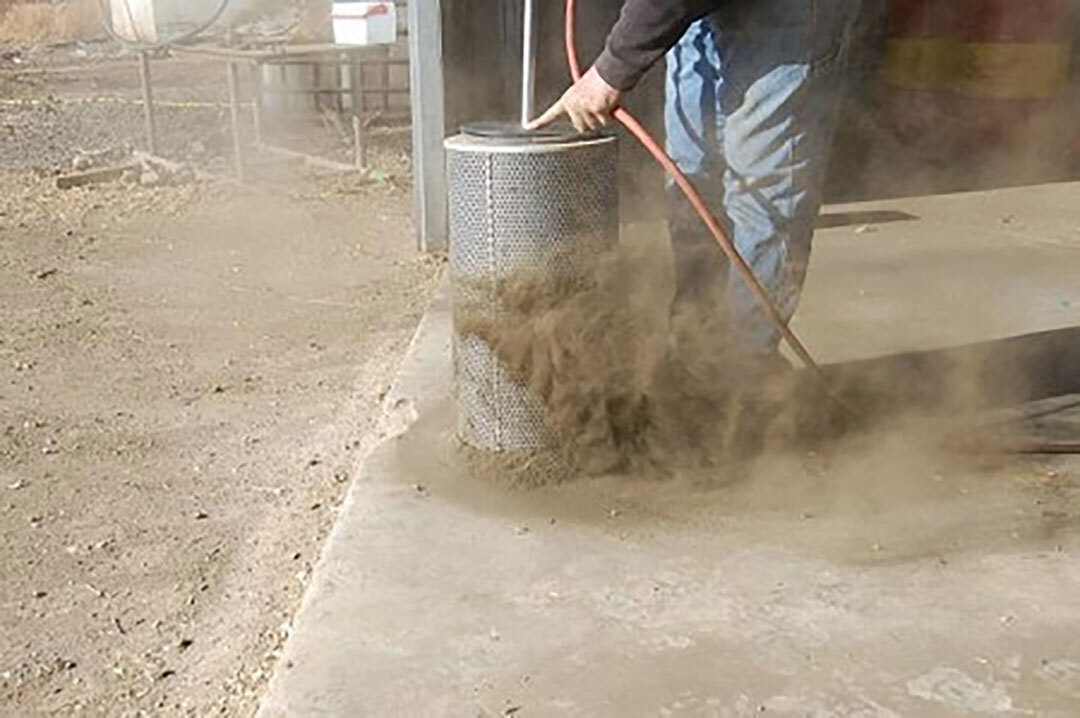
Just do not clean it with a bare nozzle off the shop compressor. That puts 135 to 150 psi against media built to see a fraction of that, and it will tear pleats or blow pinholes you cannot see. The Air Filter Blaster Portable Unit was built to fix exactly that problem: it caps the air leaving any single jacket at about 48 psi and cleans from the inside out, so the dirt exits the way it came in and the media stays whole. All it needs is a compressor with 90 psi capability, which is the same air line you already run.
Then inspect before you reinstall. Every time, no exceptions. Hold a light inside the filter and look through the media for bright spots, check the pleats for tears, and check the seal for cracks or set. If the filter is damaged, it is done, and a new filter is a whole lot cheaper than a dusted turbo. If it passes, seat it properly, close the housing, and reset the gauge. The reading should come back near where a fresh filter sits. If it locks high again in short order, the filter is at the end of its life or something else in the intake is restricting flow.
What if your equipment doesn't have a gauge?
Put one on. A lock-up indicator costs about the price of lunch for two, threads into a tap on the air cleaner outlet or the intake duct between the filter and the turbo, and takes maybe ten minutes to install. In my book, every machine that works in dust should carry one, the same way it carries an hour meter. We have been telling farmers to install restriction gauges on their equipment for years, because it turns the air filter from a guessing game into a number you can read on a walkaround. In dusty season, when a filter can go from fine to plugged in a day or two of heavy work, that number is worth a lot more than it costs.
FAQ
Does a restriction gauge work with a cleaned filter?
Yes. The gauge reads restriction, not filter age, so it does not care whether the element is new or cleaned. Reset it after servicing and the reading should return close to the new-filter baseline. If it does not, the filter is at the end of its life or the intake has another restriction.
Can rain, snow, or humidity push the reading up?
They can, temporarily. Wet media flows less air, so a locked high reading after a storm or heavy snow may not mean a dirty filter. Reset the gauge, run the machine under load in normal conditions, and see where it locks. If it comes back high and dry, service the filter.
Do I need to pull the filter to check it?
No, and that is the whole point. The gauge exists so you can know the filter's condition without opening the housing. Save the hands-on inspection for service time, after the gauge tells you the filter has hit its limit.
How often should I check the gauge?
Make it part of every walkaround, which costs you a glance. In heavy dust that daily glance matters most, because restriction can climb from fine to the red zone inside a single hard day of work.
If your gauges are telling you it is time, get the tool that makes cleaning the obvious answer. Look at the Air Filter Blaster lineup, or dig into the field trial data and see the numbers behind it.